Different African countries, political parties or even civil society organizations on the continent expressed themselves in different ways on Wednesday May 25 on the occasion of World Africa Day which commemorates the date of the signing of the agreements of the Organization of African Unity (OAU) in 1963, which became the African Union in 2002.
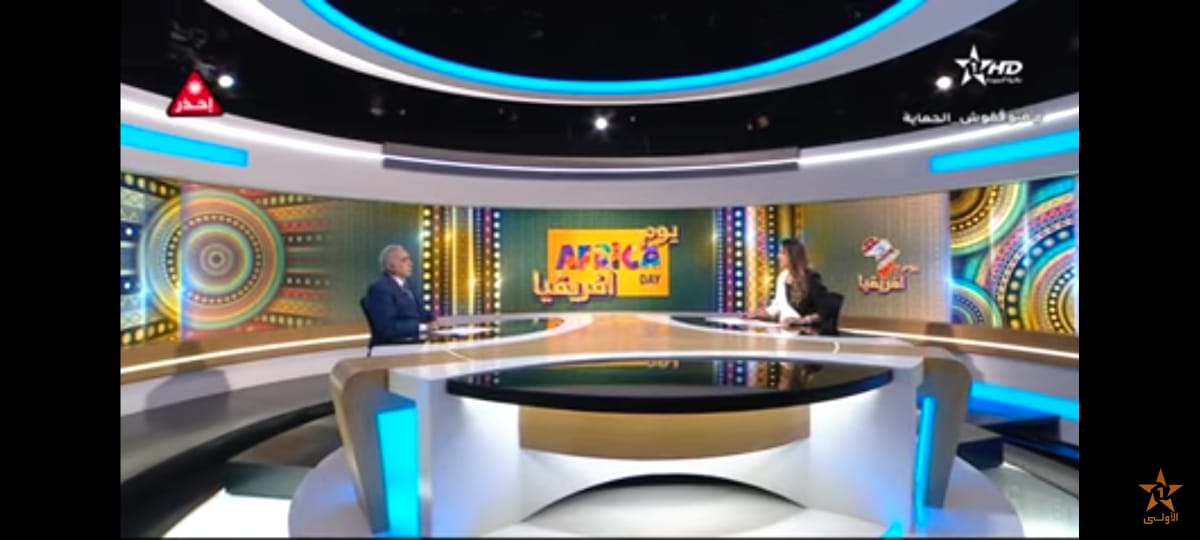
The Morocco Afrika Cultures & Developments Organization (OMA), an organization present and represented in several African countries, an emanation of African civil society, has striven, for its part, to celebrate this event, recalling certain key historical facts. This year, OMA’s Founding and International President, Dr. Najib Kettani, spoke in an interview given to Moroccan national television, during the 1 p.m. newscast, of the first meeting originally at the creation of the OAU, held in Casablanca in 1961 on the initiative of His Majesty King Mohamed V.
Between January 4 and 7, 1961, the Moroccan Sovereign had, in fact, organized a summit in Casablanca in which seven African leaders had taken part, in particular the Ghanaian Kwame Nkrumah, the Malian Modibo Keita, the Guinean Amadou Sékou Touré, the ‘Egyptian Jamal Abdel Nasser, Algerian Ferhat Abbas representing the provisional government of Algeria still under French occupation, and Abdelkader Allam representing Libyan King Idris I. As a reminder, it was this Casablanca conference that was the prelude to the creation of the OAU. The African Union (AU) was officially established in July 2002 in Durban, South Africa.
(The real reasons for this transformation of the OAU into the AU are currently the subject of studies and analyzes by the PAX AFRIKA FORUM set up by the OMA and which has already published 5 articles on this subject under the signature by Pr Alphonse Zozime Tamekamta, Ph.D in History of International Relations (African Polemology and Irenology), Ecole Normale Supérieure de Yaoundé (University of Yaoundé 1) Cameroon. See our Facebook page (@omamarocsiege) or website (www.marocafrika. org)
On May 25, 2021, the OMA launched, through its international president, a global appeal for the return of archaeological and ethnographic objects belonging to Africa, but held by Western countries.
On the occasion of the 2019 edition of World Africa Day, the NGO organized a major event in Rabat, in collaboration with the Moroccan Ministry of Culture and Communication. The ceremony was an opportunity to recall the motivations behind commemorating the Day, including highlighting Africa’s struggle for liberation, emancipation, development and progress; as well as the strengthening of the relationship between the African peoples.
The African continent shines through the richness of its heritage (cultural, historical, human, natural, etc.), despite the ills from which it currently suffers (illiteracy, wars, AIDS, water shortage, debt, etc.).
But, beyond the celebration itself, the OMA chose not to ignore the multisectoral actions carried out by Morocco, the 5th economic power of the continent, in favor of the emergence of Africa.
After having provided support to African countries for their liberation from the yoke of colonialism, from the 1960s, Morocco began by offering to friendly and brotherly countries its experiences in various fields (diplomatic, military and technical, etc.), under the impulse of King Mohammed V.
Thanks to the ambitions of its Sovereigns (Mohamed V, Hassan II, Mohammed VI) for Africa, Morocco has constantly campaigned for the sustainable development of the continent through the sharing of its expertise. The Kingdom trains thousands of executives from most countries on the continent. It also intervenes in the fields of finance, military, health, telecommunications, urbanization and many others.
It is worth highlighting two revolutions proposed by King Mohammed VI to Africa that will change the face of the continent in the 21st century. This is a share of the regional electricity market or the Morocco-Nigeria trans-African gas pipeline project. In addition to the fact that this megaproject will allow Nigeria to boost its deliveries to Europe, and Morocco to gain gas energy independence, the Nigeria Morocco gas pipeline, in the advanced study phase, will pass through Benin, Togo, Ghana, Cote d’Ivoire, Liberia, Sierra Leone, Guinea-Conakry, Guinea Bissau, Gambia, Senegal, Mauritania to arrive in Morocco and head for Europe. It will create the electricity market in West Africa necessary for any development.
During his speech delivered on January 31, 2017, before the 28th summit of the African Union (AU) in Addis Ababa, King Mohammed VI declared that this project « will indeed contribute to structuring a regional market of electricity, and will constitute a substantial source of energy in the service of industrial development, the improvement of economic competitiveness and the acceleration of social development. This project will create wealth for the countries and neighboring populations, creating a decisive momentum and leading to the emergence and development of parallel projects.
In addition, it will make it possible to establish more peaceful relations, bilateral and multilateral, and thus create an environment conducive to development and growth”.
The second revolution concerns the agricultural market in Africa. Morocco, world leader in phosphate products, shares this precious resource in the form of fertilizer with millions of farmers around the world for efficient and sustainable agriculture which will ultimately give food security to all of Africa through various investments. granted in the field of fertilizers in Gabon, Ethiopia and Nigeria, and which will make Africa the next breadbasket of the world.
“… as part of projects aimed at improving agricultural productivity and promoting food security and rural development, Fertilizer Production Units have been set up with Ethiopia and Nigeria. The benefits of this project will extend to the entire continent.
We know it: it is neither gas nor oil that will satisfy basic food needs! However, isn’t Africa’s great challenge its food security? “, also indicated King Mohammed VI in a speech.
Morocco has joined the Continental Free Trade Area (ZLEC) and also aims to join the Economic Community of West African States (ECOWAS).
All these actions were initiated under the leadership of HM Mohammed VI. Upon his accession to the throne in 1999, the Moroccan sovereign had chosen a forward-looking vision, marked by efficiency, economic performance, growth, infrastructure development, ethics and probity.
By OMA Newsletter N° 720 of 05/27/2022
The OMA, NGO with an Intercontinental vocation
For the development of cultural exchanges
Valuing human potential
The promotion and consolidation of Africa’s development, and
Inter-African integration