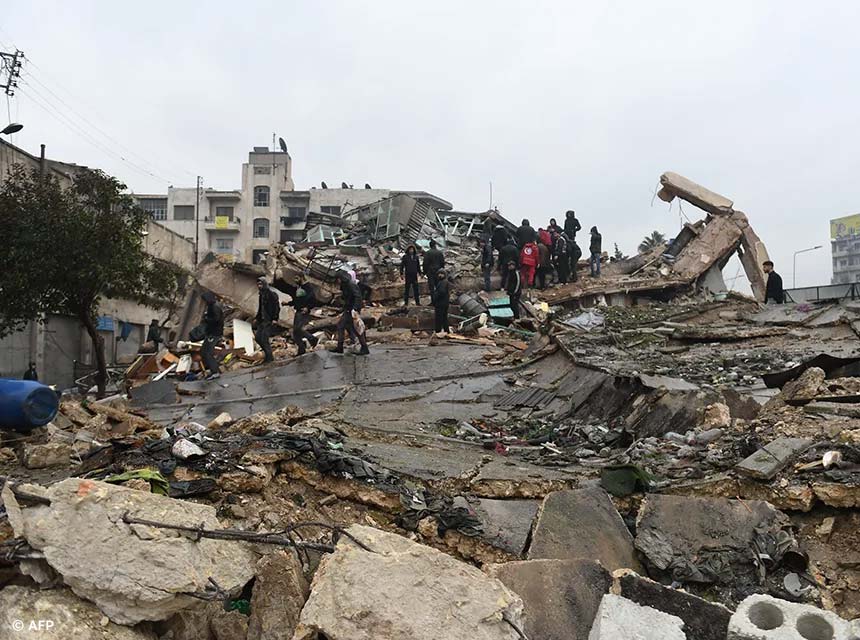
The results of the violent earthquake, with a magnitude of 7.8 on the Richter scale, which hit on Monday February 6 at 04:17 local time (01:17 GMT), at a depth of approximately 17.9 km, in the south -eastern Turkey, the localities of Kahramanmaras, Gaziantep, Adana, Malatya, Diyarbakir, Sanliurfa and Osmaniye, and in northern Syria, notably in Aleppo, Idlib, Latakia, Hama and Tartus, has sown chaos and disarray in affected regions and caused a large number of victims.
This earthquake which caused damage over an area of 500 km2 was felt over an area of 1000 km2. Turkish President Recep Tayyip Erdogan said the number of people affected by this disaster could approach 20 million and signaled a continuous mobilization of 160,000 rescuers from inside and outside Turkey.
The number of victims is only increasing, now exceeding 35,000 dead, according to official figures. Entire regions were devastated by the tremors in both countries. The latest report shows at least 35,225 dead: 31,643 in Turkey and 3,582 in Syria.
Rescue operations, carried out by national and international teams, are still continuing, with the hope of finding survivors in the rubble. During the night from Sunday to Monday, seven people were saved, according to the Turkish press, including a 3-year-old child in Kahramanmaras and a 60-year-old woman in Besni.
The aid promised by several countries around the world is gradually arriving. But the Turkish state is being criticized for its handling of the aftermath of the earthquake. On Wednesday February 8, the Turkish president recognized « gaps » in the response to the earthquake. “Of course there are shortcomings, it is impossible to be prepared for such a disaster,” he said.
Turkey is considered a strategic partner of Africa and recognized as such in January 2008 by the African Union, and through the Istanbul summit, a real framework for socio-economic and political cooperation between Africa and Turkey and which is the instrument for implementing the Istanbul Declaration on Partnership.
This partnership defines eight priority action areas for the development of African countries through the promotion of intergovernmental cooperation, peace and security, trade and investment, agriculture, agro-industry, rural development , water resources, management of small and medium-sized enterprises, health, infrastructure, transport, and telecommunications, culture and education, as well as the media and new information and communication technologies .
However, the drafters of the Africa-Turkey agreements did not think of including in these agreements actions and humanitarian aid to be granted to a partner in difficulty in the face of a natural disaster…
Faced with this tragedy experienced by the Turkish and Syrian peoples, the Morocco Afrika Cultures and Developments Organization, OMA, expresses its deep condolences to the peoples of the two countries and to the families bereaved by this tragedy which only increases the number of victims and wounded, and calls for African solidarity through a strong mobilization of Africa, to come to the aid of the two countries affected by the disaster.
The aid to be provided to Turkey, and through it to Syria, can be organised, pooled and coordinated by the various regional bodies such as:
The Economic Community of West African States (ECOWAS)
The Common Market for Eastern and Southern Africa (COMESA)
The Economic and Monetary Community of Central Africa (CEMAC)
The Southern African Development Community (SADC)
The East African Community (EAC)
The Economic Community of Central African States (ECCAS)
The delivery of aid could be provided by the Turkish airline, Turkish Airlines, which serves several African destinations.
Above all, Africa cannot and must not be absent from this humanitarian action and should provide its share of relief to the thousands of victims affected by this tragedy.
By OMA Newsletter N° 1044 of 13/02/2023
Article published under the direction of Dr. Najib Kettani
The OMA, NGO with an Intercontinental vocation
For the development of cultural exchanges
Valuing human potential
The promotion and consolidation of Africa’s development, and
Inter-African integration