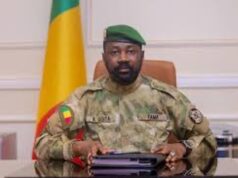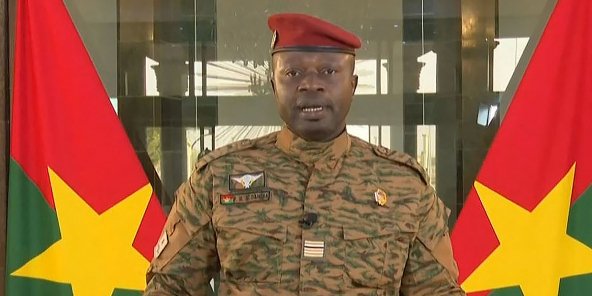
The President of the Transition in Burkina Faso, Paul-Henri Sandaogo Damiba, who was forced to resign by Captain Ibrahim Traoré, laid down seven conditions before leaving office, including compliance with commitments made with the Economic Community of West African States (ECOWAS), according to a statement by the leaders of the religious and customary communities who mediated between the two men, published on Sunday 2 October.
Their text affirms that “the President of the Patriotic Movement for Safeguarding and Restoration (MPSR), Captain Ibrahim Traoré, has accepted these seven conditions”, and invites “the population to calm, restraint and prayer for our dear fatherland Burkina Faso”.
Damiba’s other conditions are the continuation of operational activities on the ground; the guarantee of the security and non-prosecution of the FDS engaged at his side; the continued strengthening of cohesion within the FDS; the pursuit of national reconciliation; the pursuit of state reform; as well as the guarantee of its safety and its rights, as well as those of its collaborators.
For its part, ECOWAS said in a statement on Sunday that it had taken note of Lieutenant-Colonel Damiba’s decision to resign as president. “I take note in particular of the decision of Lieutenant-Colonel Paul-Henri Sandaogo Damiba to resign as president of the transitional government of Burkina Faso, in order to avoid a violent confrontation and a possible bloodbath,” said from Umaro Sissoco Embalo, current President of ECOWAS and Head of State of Guinea Bissau.
This West African official hailed the “peaceful settlement” of the conflict by the various parties, before also calling on the Burkinabè authorities to “respect the commitment made with ECOWAS”.
Burkina Faso appears to be the star performer among military-ruled countries in the sub-region. On the eve of an ECOWAS summit, held on September 22 in New York, on the sidelines of the UN General Assembly, on the “review of the situation in Guinea and Mali”, Embalo had seemed to display his satisfaction with the transition in Burkina which, according to him, “respects the roadmap” agreed with ECOWAS.
It remains for the new leader of the country to also keep his commitment in this context. Captain Traoré overthrew the power of Damiba on Friday September 30 by a coup d’etat. The latter was in turn at the head of the soldiers who had deposed the elected president Roch Kaboré by a putsch.
By OMA Newsletter N° 879 of 03/10/2022
Article published under the direction of Dr. Najib Kettani
The OMA, NGO with an Intercontinental vocation
For the development of cultural exchanges
Valuing human potential
The promotion and consolidation of Africa’s development, and
Inter-African integration