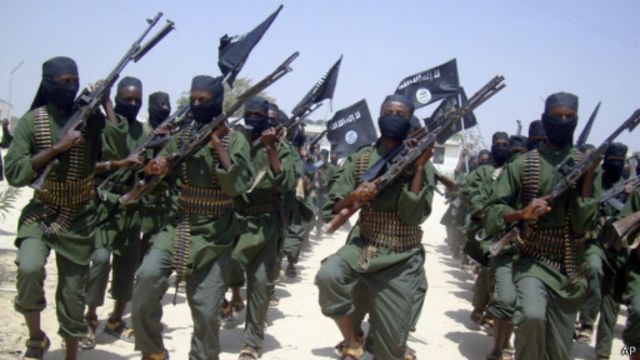
The United States is looking for three main leaders of the Somali terrorist group Al-Shabaab, and ready to give an amount of six million dollars, which has just been increased to 10 million dollars, in exchange for information about these people.
In a statement, the American Embassy in Kenya indicates that “the rewards program (…) of the United States Department of State is increasing its offers of rewards up to 10 million dollars each for information allowing to identify or to locate the main Shebab leaders Ahmed Diriye, Mahad Karate and Jehad Mostafa”.
Ahmed Diriye has been at the head of the group since 2014, Mahad Karate is said to be the movement’s number 2, and Jehad Mostafa is considered “the leader in the use of explosives” for attacks. According to the embassy, this last official, an American national, is seen by the FBI as “the highest ranking terrorist of American nationality fighting abroad”.
In addition to the information about these three people, Washington also promises a reward for any information “leading to the disruption of the financial mechanisms of Shebab”, specifies the press release, acknowledging that this is “the first time that the Department (of State ) offers a reward for information on Al-Shabaab’s financial networks”.
Al-Shabaab, affiliated with Al-Qaeda, has been fighting the government for many years. The new Somali president, Hassan Sheikh Mohamoud, who promised a merciless war against the movement, was quick to take action. According to the government, the Somali army, supported among others by American troops, have already recovered certain areas which were under the control of the Shebabs.
But, at the same time, the terrorist group is also talking about it by continuing its murderous attacks, as if to defy the new authorities.
By OMA Newsletter N° 937 of 15/11/2022
Article published under the direction of Dr. Najib Kettani
The OMA, NGO with an Intercontinental vocation
For the development of cultural exchanges
Valuing human potential
The promotion and consolidation of Africa’s development, and
Inter-African integration