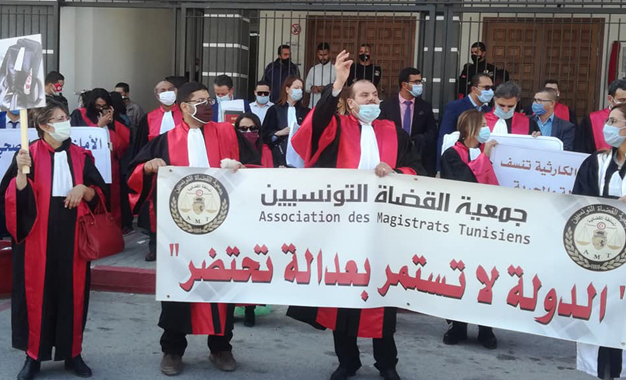
In Tunisia, the magistrates have chosen to show their fed up with the “permanent interference” of President Kaïs Saïed “in the judiciary” by a one-week renewable strike, which began on Monday 6 June.
The watchword was decreed by the main professional unions of magistrates angry with the Head of State who continues to take decisions affecting their professional body at will. The strike would be “very followed” in all the courts, on the national territory, according to some union officials.
The latest challenged initiative of the president is the dismissal, on June 1, of 57 judges. The Tunisian number one accuses them, according to the Official Journal, of “concealment of terrorist affairs”, “corruption”, “sexual harassment”, “collusion” with political parties and “disruption of the functioning of justice”. For him, this decision, which he described as “historic”, is about “purifying” the judiciary.
The magistrates are all the more reassembled as the president has granted himself the power to dismiss the judges “without the slightest recourse” possible. Among those who have been sacked and who may face prosecution are a former spokesman for the counter-terrorism unit, a former director general of customs and the former president of the Superior Council of the Judiciary (CSM). .
The dismissals also concern magistrates suspected of having obstructed the investigation into the 2013 assassinations of two left-wing leaders, Chokri Belaid and Mohamed Brahmi, by suspected jihadists.
Saïed’s multiple decisions are increasingly worrying the political class. Last April, the opposition announced the creation of a coalition, baptized “National Salvation Front”, aimed at bringing together many political parties and civil society organizations, and working for the restoration of the process democratic and constitutional, without forgetting the protection of freedoms and rights in the country.
At the international level, the same story. Recently, a European Commission for Democracy through Law, known as the “Venice Commission”, criticized the holding of a referendum on a new Constitution scheduled for 25 July next, stressing that the decree of the Head of State calling on the voters at this meeting is not in conformity with the Constitution.
Saïed reacted firmly to this “interference in Tunisian internal affairs”, asking the members of the said Commission to leave Tunisian territory.
By OMA Newsletter N° 731 of 07/06/2022
Article published under the direction of Dr. Najib Kettani
The OMA, NGO with an Intercontinental vocation
For the development of cultural exchanges
Valuing human potential
The promotion and consolidation of Africa’s development, and
Inter-African integration